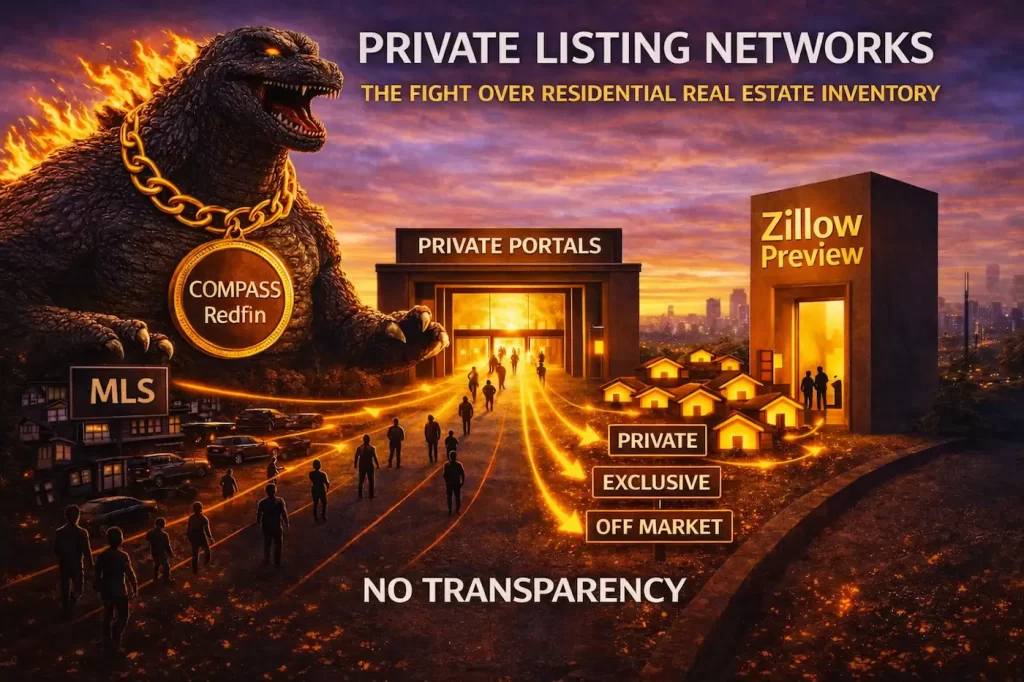

Zillow Preview is being sold as early access and more visibility, yet the deeper shift is control. Zillow Group launched the product on March 17, 2026, giving partner brokerages a way to place pre market listings on Zillow and Trulia before full MLS activation.
Buyers are promised earlier access. Sellers are promised more exposure. The platform gains something far more important: first position in the distribution chain.
This matters because first exposure shapes everything that follows. The battle is no longer just over listings. It is over who controls inventory, who controls inquiry flow, and who captures the economics created by both. That is the same larger fight already visible in Private Listing Networks and in the broader market structure shift outlined in real estate brokerage consolidation.
Zillow Preview changes who controls first exposure
Zillow spent years functioning as a display layer built on listing data created somewhere else. Zillow Preview moves the portal closer to the center of the transaction. The platform is no longer only showing inventory. It is helping determine where some inventory appears first, how it is framed, and how consumer attention is routed around it.
The mechanics are simple enough. Partner brokerages send upcoming listings directly to Zillow before full MLS exposure. Zillow publishes them on Zillow and Trulia with Preview branding. The public sees the listing earlier than it otherwise might. The portal gains a larger role in organizing that demand before the market is fully open.
- Brokerages can submit pre market listings directly to Zillow.
- Listings can appear on Zillow and Trulia before full MLS activation.
- Zillow gets a larger role in shaping inquiry flow around those listings.
- The MLS begins to look less like the first stage of exposure and more like the second stage.
The marketing language sounds consumer friendly. The structure points somewhere else. This is a distribution strategy.
Zillow Preview gives buyers access but less transparency
Buyers do gain something from Zillow Preview. They may see certain homes earlier. That is real. The question is whether earlier access inside a portal controlled channel produces a better market for the buyer. That answer is much less clear.
Visibility is not the same thing as transparency. A pre market listing inside a portal controlled system does not offer the same market signal as a listing broadly exposed through the ordinary cooperative process. Buyers may see the home earlier while understanding less about the full competitive context around it.
- Buyer access begins inside a portal controlled environment rather than a fully cooperative one.
- Inquiry flow is shaped by the platform rather than by a neutral market structure.
- Competitive context may be weaker than under full MLS exposure.
- The buyer enters a system designed to capture transaction flow, not simply inform consumer choice.
The consumer language matters because it softens what is really happening. The portal is not only helping buyers find homes. It is helping determine how those buyers move through the system.
Zillow Preview narrows what sellers may actually gain
Sellers hear the appealing version first. More visibility. Earlier momentum. A chance to generate interest before the full launch. Those claims sound additive. They imply the seller is getting extra marketing before the real listing process even begins.
The harder question is what the seller gives up, narrows, or delays by entering the market through a controlled preview channel instead of broad cooperative exposure from day one. Price discovery depends on reach, competition, and clarity. A siloed first stage may weaken all three.
- Narrower buyer access than a fully active MLS launch.
- Lead flow shaped inside the portal rather than directly by open market competition.
- Reduced clarity around the true level of demand.
- More dependence on platform economics rather than seller centered strategy.
Zillow’s own prior research on privately marketed listings raised the concern that reduced open exposure can hurt seller outcomes in competitive California markets. The point is not that every Preview listing will produce the same result. The point is that controlled exposure changes incentives, and those incentives do not belong only to the seller.
Zillow Preview is a portal control strategy first
Zillow describes Preview as a transparency move because listings that might otherwise remain hidden become visible online. That claim is partly true and still incomplete. A listing shown first through a proprietary portal channel is more public than a pure private listing. It is not the same thing as a neutral open market.
The difference is economic. Once the portal becomes the place where first attention flows, it gains leverage over listing visibility, brokerage relationships, recruiting, lead routing, and the consumer relationship itself. That is why Zillow Preview matters as a structural event, not merely a product launch.
The firm does not need to own the listing brokerage to influence the transaction. It only needs to become the path through which early demand is organized. That is what portal control looks like in practice.
Zillow Preview also strengthens brokerage recruiting leverage
Zillow Preview is not only a consumer product. It is also a recruiting asset for partner firms. Brokerages can now suggest that alignment with the right platform produces better early exposure, more visibility, and better positioning for future listings.
That logic fits perfectly inside the larger consolidation fight. Big brokerages, big portals, and legacy institutions all claim consumer benefit while competing for control of inventory and market share. The language is consumer friendly. The incentives are not. Every major player wants to control first exposure because control of the listing still drives everything else.
That is why this issue belongs in the same conversation as private listing strategies, MLS weakening, and brokerage concentration. The public explanation is convenience. The strategic reality is control.
Zillow Preview matters to investors because signal quality matters
Investors depend on clean signals. Exposure history, pricing adjustments, competitive response, and time on market all matter when evaluating value, timing, and yield. Systems that fragment those signals make analysis weaker.
That matters from Downtown Los Angeles to Santa Monica’s waters edge, and from the Hollywood Sign to Playa del Rey. Pricing logic differs sharply across Beverly Hills, West Hollywood, Century City, Santa Monica, Malibu, and the core Los Angeles neighborhoods between them. Investors do not benefit from market opacity dressed up as convenience.
For serious buyers, serious sellers, and serious investors, cleaner distribution still matters. The more the system is filtered through portal incentives, the more carefully the underlying data has to be read.
The Angelino Advisor view is independent by design
This is where The Angelino Advisor matters. The point is not to condemn every pre market strategy. The point is to understand who benefits from the structure before recommending it to a client.
Native Angelino Real Estate does not participate in portal incentive structures. We are not trying to route a buyer through a platform controlled funnel. We are not using portal alignment as a recruiting pitch. We are not building strategy around who owns the lead. We are building strategy around what serves the client.
- Full market reach without portal filtering.
- Direct representation across primary Los Angeles markets.
- Transparent data supporting stronger pricing and timing decisions.
- Execution driven by client objectives rather than platform economics.
From Downtown Los Angeles to Santa Monica’s waters edge, and from the Hollywood Sign to Playa del Rey, we know Los Angeles.
Tom Levine | Native Angelino Real Estate | Los Angeles | CADRE 02052698
Boutique Brokerage | Independent By Design
Sources
- Zillow continues turning on the lights: Introducing Zillow Preview
- Zillow Preview gains early momentum as brokerages embrace public pre market listings
- Zillow launches Zillow Preview to bring pre market home listings into the open
- Private Listing Networks
- Real Estate Brokerage Consolidation
- The Angelino Advisor
Tom Levine | Native Angelino Real Estate | Los Angeles | DRE 02052698
A Boutique Brokerage | Independent By Design