
Tom Levine is a Los Angeles native, real estate advisor, broker and host of the Native Angelino Podcast. 25+ years advising clients on financial and real estate portfolios.
Private listing networks delay MLS entry, reduce seller property exposure and limit buyer access.
The closed loop system primarily benefits the real estate brokerage and portal. Information is walled off and proprietary. Sellers lose exposure and buyers lose access in every market the system reaches. Los Angeles is not insulated from damage.
Portal Wars | Private Exclusives and Pocket Listings
The modern MLS is built on one rule: every listing, visible to every buyer, via syndication, at the same time.
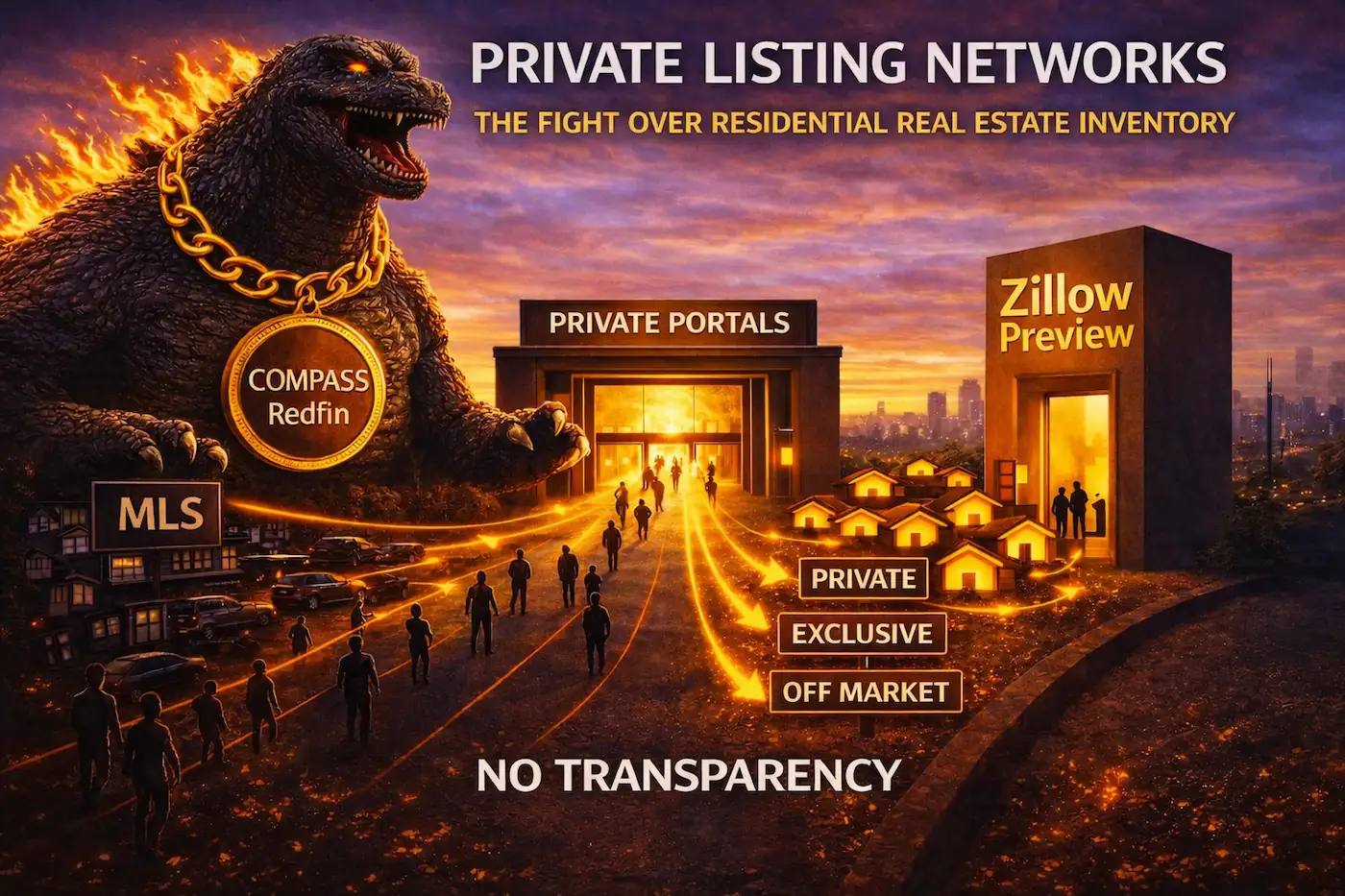
In the spring of 2026, Compass, Zillow, and eXp each struck separate deals to route residential real estate inventory through channels of their own design.
None of these channels connect.
Private Listings | Separate Channels Are Not Equal
Siloed audiences, separate rules and lack of transparency define the new era.
Compass and Rocket Companies struck a three-year deal in February 2026. Coming Soon listings began appearing on Redfin on March 16, with Private Exclusive listings to follow.
Listings display without days on market or price reduction history. Leads are routed directly back to the listing agent and the controlling real estate brokerage.
Zillow launched Zillow Preview on March 17, 2026, with Keller Williams, REMAX, HomeServices of America, Side, and United Real Estate. Twenty-four additional brokerages signed within the first week.
eXp struck a parallel Coming Soon deal with Realtor.com, Homes.com, and ComeHome.com the same week. Each program routes leads back to the originating network.
A buyer searching all three portals in Los Angeles is seeing three different subsets of the larger market.
This is the frontline of the raging portal war.
The forces behind these moves are examined in our analysis of real estate brokerage consolidation .
From Analog to Digital | The Evolution of Pocket, Private, and Off-Market Listings
The history of the pocket listing is the history of a small exception turning into a large, formidable business model. What began as an individual judgment call between a seller and a single agent has become a structured program operated by national real estate brokerages and consumer-facing portals. The shift is from bespoke necessity to industrialized capture.
Pocket Listings to Portal Networks | The Mainstreaming of the Exception
For most of the modern MLS era, a pocket listing meant something specific. A seller wanted privacy. The home was singular. The asking price needed a quiet test before formal launch. The category was small, and the use cases were specific.
Three legitimate use cases accounted for the vast majority of private listings.
- A seller is navigating the three Ds: divorce, death, or debt. A lawn sign or portal listing is an invitation for unwanted local attention during a fragile transition.
- Some estates are themselves works of art. They have no real comparables. Selling one is closer to placing a piece of art with the right collector than running price discovery on the open market. The transaction requires sales skills, specialized knowledge of the asset, and a curated buyer pool. Public listing can damage the asset if the perceived value of the home falls due to a "common" offering method.
- The health and security case applies to sellers with valuable on-site collections, fame, or compromised health who need to vet every visitor before the door opens.
Outside those cases, the practice of private listings evolved into something else. Starting with technology adoption in the 2000s and blossoming in the 2020s, the largest brokerages converted the exception into infrastructure.
They built Digital Walled Gardens around their listings and required buyers to come to the firm to see the inventory inside.
The driver was not seller benefit. The driver was the double end commission, the ability to capture both the buy and the sell side of a transaction by keeping the deal within one network. The strategy protects margins, potentially enhances profits, and grows market share.
The National Association of Realtors recognized the threat. The 2020 Clear Cooperation Policy required any listing publicly marketed to enter the MLS within one business day. The rule was a defense of the cooperative principle, an attempt to provide access to information on a timely basis without second layer gating from private portals or in-house systems.
The defense did not hold. In 2025, NAR added a Delayed Marketing Exemption that opened a legal carve out for staying off consumer portals. In early 2026, Compass, Redfin, Zillow, and eXp announced separate alliances built directly on top of that carve out.
Compass Private Exclusives now appear on Redfin during a Coming Soon window, Zillow Preview runs across dozens of brokerages, and eXp Coming Soon listings appear on Realtor.com and Homes.com. Every program operates inside the letter of the rule while bypassing its spirit. The exception is no longer rare. It is trending toward the rule.
Zillow's pitch, from CEO Jeremy Wacksman:
"Zillow Preview shines a light on listings that might otherwise stay hidden, giving buyers open access to their options and sellers the broad exposure they deserve."
Every program in this category claims a consumer benefit. Every program is incentivized to reward the platform. The gap between what is said and what is incentivized is where the consumer is most likely to be disadvantaged.
The seller is sold exclusivity as a benefit, but exclusivity narrows the buyer pool by design. A smaller pool of buyers competing for a property is not the seller's interest. It is the platform's.
The buyer pays for the shift in a different currency, the time and friction of searching across multiple separate networks just to see the full inventory. The fiduciary question for either side is no longer which brokerage to use, but whether the advisor representing them is aligned with the client or with the platform.
Zillow Says California Sellers Lost Thousands Going Off the MLS
Zillow Research analyzed 10 million residential transactions across 46 states in 2023 and 2024 in a study published February 14, 2025. Sellers who marketed homes off the MLS received a median of $4,975 less per transaction nationally.
California sellers absorbed the steepest losses. The median gap reached $30,075, or 3.7 percent below comparable MLS listed properties.
Why California Is Six Times the National Gap
California's dollar gap runs roughly six times the national median. The percentage gap is also wider.
Two reasons drive this.
California carries deeper buyer pools per listing than most states. Pulling a home off the MLS removes more competing bidders than the same move does in a thinner market. Fewer bidders, lower clearing price.
California also had tighter MLS participation among licensed agents historically. Pocket listing culture in the mass market was less entrenched here than in Florida, Texas, or the Northeast. The MLS was the default price discovery mechanism. When a seller exits it, the penalty shows up in the sale price.
That premium held across every price tier. It did not disappear in upper-market segments, where agents make the private listing argument most aggressively.
The Ground Truth in the Los Angeles Neighborhoods I Work In
Fun with statistics means the same data can be read to say what the presenter needs it to say. In this case, the stats are important directionally.
They back the larger argument on this page: consolidation, portal control, lack of transparency, and possible steering concerns.
The analysis held nationwide. It held in California. In the high value Los Angeles neighborhoods I work in, Beverly Hills, West Hollywood, and the Wilshire Corridor, it almost certainly held as well.
Legitimate use cases for off market and private listings exist. I have written about them elsewhere.
A client who needs privacy for reasons that will not change with a better marketing plan. An estate sale where the heirs are not ready for public showings. A pricing test before a public launch.
Those cases are real and they are narrow. They are not the default, and they are not what a typical seller is being pitched when a brokerage routes them into a private network first.
Whether the programs now forming produce the same outcome is unknown. The data does not yet exist.
The MLS | Transparency | The Principle Portal Deals Violate
The cooperative principle behind the MLS is straightforward: shared inventory, syndication across many platforms, equal access and every buyer and seller has timely access to information.
The Council of Multiple Listing Services stated on March 25, 2026, that siloing and hiding information weakens competition and moves the market toward fragmentation.
Compass CEO Robert Reffkin told investors the Redfin deal marks the end of MLS restrictions on how agents and sellers market homes. Multiple MLS organizations disputed that claim immediately and stated their intention to maintain existing rules.
That dispute is not settled; it is opening a new phase of argument.
Private Listing Networks Reward the Platform Not the Consumer
Virtually every executive statement attached to these portal programs invokes free-market rhetoric and consumer benefit. Buyers will see more inventory. Sellers will have more choice.
These statements are unlikely to prove accurate as the portal wars develop. Pontification by executives whose firms earn revenue by controlling the first point of listing exposure and routing the leads that follow is far from consumer first with transparency as the guiding principle.
Zillow Changed Its Own Position
Zillow opposed pocket listings for years. The company publicly backed the MLS Clear Cooperation Policy, the NAR rule that a listing must hit the MLS within one business day of public marketing. Zillow treated off market inventory as a threat to transparent pricing.
That position has shifted. Zillow now operates its own pre market listing channel, Zillow Preview, launched March 2026.
Pre market and early access are the workaround. A listing routed through a brokerage private channel or Zillow Preview before it hits the MLS is already being marketed to buyers and sellers. Short window control is still control. The objective is to hold attention on the platform first, protect margin, and defend market share.
Three forces drove the reversal.
The NAR settlement of March 2024, implemented August 17, 2024, reset commission disclosure and agent conduct rules.
Compass expanded its Private Exclusive program and went public in its fight with NAR over Clear Cooperation.
The broader googlization of real estate, the consolidation of search, listings, and client data into a handful of platforms, made sitting out uneconomic. I have written about googlization elsewhere on this site.
The relevant point is narrower. Zillow's own research says off MLS costs California sellers $30,075. Zillow simultaneously operates a channel that routes listings onto its own portal before the MLS.
Steering Is the Regulatory Pressure Point
Steering, in real estate, means directing a seller or buyer toward a channel or outcome that serves the agent or brokerage more than the client.
The NAR Code of Ethics addresses it. The Fair Housing Act addresses it.
HUD has flagged that off MLS listings can reduce exposure to protected classes and produce disparate impact without intent. Zillow's own February 2025 study found Hispanic sellers were recommended to list on private networks at a 74 percent rate and Black sellers at 73 percent, against 24 percent for white sellers. That is not HUD framing. That is Zillow's own data.
The U.S. Department of Justice Antitrust Division has filed Statements of Interest in real estate broker competition cases and continues to press on commission and broker conduct rules.
State attorneys general have opened inquiries.
Routing a seller into a brokerage's private network without full disclosure of the price impact, the narrowed buyer pool, and the alternative of a standard MLS listing sits inside that definition.
That is the regulatory pressure point, and it is live.
Private Listing Network Terms
- Private listing network
- A private listing network is a brokerage or platform channel that markets a home for sale to a restricted audience of buyers, usually the brokerage's own agents and clients, rather than submitting the listing to the MLS where all licensed agents and public portals can see it. Also called a private network, walled garden, or exclusive listing channel.
- Walled garden
- A walled garden, in real estate, is a brokerage or platform strategy of confining listings and buyer leads inside a proprietary network rather than sharing them through the MLS and open portals. Industry commentary refers to these systems as Digital Walled Gardens to distinguish them from legitimate privacy arrangements between a seller and a single agent.
- MLS (Multiple Listing Service)
- The MLS, or Multiple Listing Service, is the cooperative database real estate brokerages use to share active listings with each other and syndicate them to public portals. Entry to the MLS triggers equal access for all participating agents and, through data feeds, for consumers searching on Zillow, Redfin, Realtor.com, and similar sites.
- Clear Cooperation Policy
- The Clear Cooperation Policy is the National Association of Realtors rule (MLS Statement 8.0) requiring a listing to be submitted to the MLS within one business day of any public marketing to consumers, including yard signs, social media posts, and brokerage websites.
- Coming Soon
- A Coming Soon listing is an MLS status marking a home that is under listing agreement but not yet available for showings or offers. Large brokerages have also branded their own Coming Soon programs that display pre-market listings on affiliated portals ahead of broad MLS syndication.
- Delayed Marketing Exempt Listing
- A Delayed Marketing Exempt Listing is a category created by NAR's March 2025 Multiple Listing Options for Sellers policy. The listing must be submitted to the MLS for agent cooperation but is excluded from IDX feeds and public portal syndication for a defined window.
- Off MLS
- Off MLS describes a home actively for sale that is not listed on the MLS. Industry players use "off market" and "pocket listing" interchangeably with "off MLS," though technically "off market" can also describe a property not currently for sale at all.
- Real estate portal
- A real estate portal, also known as a listing portal, is a consumer-facing website that aggregates home listings for search and discovery. Compass, Redfin, Zillow, and eXp operate listing portals that compete for inventory and for the consumer leads that result.
- Brokerage consolidation
- Brokerage consolidation is the ongoing concentration of residential real estate transactions into a smaller number of large brokerages and portal platforms, producing higher agent counts and larger shares of listings, leads, and commission revenue inside single firms.
- Steering
- Steering is the act of directing a seller or buyer toward a channel or outcome that serves the agent or brokerage more than the client. It is addressed under the NAR Code of Ethics and the Fair Housing Act.
Three Questions Worth Asking Any Agent in Los Angeles
1. Where does a listing appear first, and who controls that decision?
Currently, the listing brokerage, not the MLS decides. Large firms often debut properties in their own "walled gardens" or through private portal deals. This gives internal agents a head start before the public ever sees the home.
While this may feel "exclusive," by nature it limits a seller's total market exposure. By the time a home hits the open MLS, early marketing access has already been funneled through a single corporate entity. Thus, offering an inherent advantage and possible bias to in-house agents.
2. What does the agent's firm earn if buyer and seller come from inside the same network?
When both parties are within the same network, the brokerage "double-ends" the deal, capturing 100% of the commission gross.
By keeping the transaction in-house, the firm avoids paying an outside brokerage, effectively doubling its revenue on a single property sale while potentially limiting the seller's exposure to the broader market.
This "closed-loop" transaction is the primary financial incentive behind brokerage consolidation. While marketed as a "seamless experience," the primary beneficiary is often the platform's bottom line, as it maximizes corporate "capture rate" by restricting inventory to its own internal ecosystem.
3. Does the recommended strategy serve the client's interest in maximum exposure, or the platform's interest in capturing both sides of the commission?
These questions have existed in the business of residential real estate for decades.
The architecture under construction across the country, in both minor and major markets like Los Angeles, makes clear answers harder to ascertain and more expensive to get wrong.
Sources
Rocket Companies. “Compass and Rocket Form Historic Alliance to Dramatically Increase Home Listing Inventory on Redfin.” PR Newswire, February 26, 2026. prnewswire.com
Zillow Group. “Zillow Launches Zillow Preview to Bring Premarket Home Listings into the Open.” PR Newswire, March 17, 2026. prnewswire.com
Zillow Research. “Off MLS Home Sellers Left More Than $1 Billion on the Table the Past Two Years.” February 2025. zillow.com/research
Council of Multiple Listing Services. “Statement on Private Listings and Market Fragmentation.” March 25, 2026.
Real Estate News. “Industry Leaders Continue to Weigh in on Zillow Preview.” March 31, 2026. realestatenews.com
Consumer Federation of America and National Urban League. “Escalating Housing Costs, Hidden Listings.” April 16, 2026. consumerfed.org
U.S. Department of Justice. “Department of Justice Files Statement of Interest Supporting Competition Among Real Estate Brokers.” December 2025. justice.gov
Inman. “Zillow Preview Is Not The Answer. It’s The Acceleration.” March 20, 2026. inman.com
Zillow. “If a Listing Is Online, It Should Be Online Everywhere: Zillow’s New Listing Access Standards.” April 2025. zillow.com