

Real Estate Brokerage Consolidation The New Power Grab
By Tom Levine
Tom Levine is a Los Angeles native, real estate advisor, broker and host of the Native Angelino Podcast. 25+ years advising clients on financial and real estate portfolios.
Real estate brokerage consolidation is shifting control of listings and distribution toward a small number of firms.
As information has become more accessible, traditional brokerage advantages and commission structures have come under pressure, driving large firms to consolidate and partner with portals to capture client listings and market share.
The Collapse of Brokerage Economics and the Shift to Consolidation
Technology, transparency, legal pressure, and AI have degraded traditional brokerage economics. The biggest firms know it.
The historical brokerage model rested on two advantages: information asymmetry and fixed compensation. Technology destroyed the first. Litigation weakened the second.
Transparency has split into two different forces. Information is now widely available and inexpensive, which has eroded the traditional brokerage advantage.
In response, the largest firms have moved to control distribution to preserve market share and protect margins, limiting where and when listings are visible. Consumers may have more access to data, but less visibility into the actual inventory that drives real decisions.
What remains is a raw competition for data, distribution, and control. The largest firms have demonstrated that real estate brokerage consolidation and alliances with information hubs and service providers are now the most defensible response.
They are pursuing mergers and acquisitions, portal alliances, private listings, premarketing schemes, and oligopolistic control not just to grab power and profitability, but to defend themselves against competition in a marketplace where open access to information and inexpensive interfaces continue to compress margins and commoditize the brokerage model.
The Googlization of information has come full circle. I have been saying this for years. The evidence is now clear.
Real estate brokerage consolidation has entered the oligopolistic phase on its way to a duopoly.
Whoever controls first exposure controls the lead. Whoever controls the lead controls the commission.
The Consumer Choice Narrative
Every major player in this consolidation wave is using the same language. Sellers get flexibility. Buyers get visibility into inventory before it reaches the broader market.
The system becomes more efficient. Choice expands. That is the pitch.
Real Estate Executives Frame Consolidation as Enhancing Access
Zillow's Errol Samuelson described Zillow Preview as making premarket listings available to everybody on the internet. Compass frames its three phase marketing strategy as seller empowerment.
These are not fabricated statements. They are incomplete statements.
The gap between what is said and what is incentivized is where consumers get hurt.
Language Obscures Brokerage Economics and Market Control
When a portal calls premarket access transparency, it is simultaneously building a proprietary inventory channel that agents outside its ecosystem cannot access on the same terms.
When a brokerage calls private listings seller choice, it is creating conditions in which a seller may accept an offer before the broader market ever had a chance to compete for the property.
Zillow's own research found that sellers who list privately sell for less, with the gap reaching over 3.7 percent in California markets. That fact does not lead the press release. It never does.
I covered this dynamic in Is Compass Anywhere Bad for Home Buyers and Sellers and A Shot at Zillow Compass Exclusive Listings in 2025. The incentive structure was visible then. It is just larger now.
Brokerage Economics and Commission Pressure
When commissions compress, a standard brokerage transaction becomes harder to defend economically. The response from large firms is not to accept lower margins.
The response is to control more of the transaction.
Falling Fees Make Listing Flow More Valuable
I wrote about the underlying pressure in Real Estate Agent Compensation on 1929.live in February 2022, four years before the Compass Anywhere merger closed.
Control listing flow, and you control lead generation before the open market sees the property. Control the lead, and you control which agent represents the buyer.
Control the buyer's agent, and you keep both sides of the commission inside the firm.
Industry analyst Steve Murray estimated the combined Compass and Anywhere entity accounts for the mid 20s in total transaction volume. At that scale, internal capture is not a feature. It is the business model.
Recruiting Retention and In House Economics Shape Strategy
Every major move in 2025 and 2026, the Compass Anywhere merger, the Compass Redfin distribution agreement, and Zillow Preview, has a second function that rarely leads the announcement. It is a recruiting tool.
A brokerage that offers its agents premarket exposure on the largest portals, guaranteed lead routing, and double sided commission opportunities is a more attractive employer than one that cannot.
Recruiting productive agents and keeping them is the core economic challenge of the brokerage business. Platform control solves that problem in a way that cooperative marketing never could.
A senior executive from one of the Zillow Preview launch partners posted on social media the day the program launched: "More Exposure, More Marketing, More Opportunity, More Leads, More Engagement, More Transparency, More Listings equals Brokerage Name. Are you aligned with the right brand?"
That post is the entire recruiting argument in one sentence.
The New Market Structure
Long before consolidation became the headline, technology, transparency, legal pressure, and AI were already pushing residential real estate toward lower commissions, unbundled services, and sharper segmentation between commodity transaction work and true advisory value.
The shift did not begin with litigation. Litigation accelerated it.
Real Estate Agent Compensation Are Commission Rates and Fees Too High
I have been asking this question since 2022. Fixed commission structures make less sense as information becomes cheaper.
The marginal contribution of a transactional agent becomes harder to defend when a buyer can access comparable sales, price history, and neighborhood data before the first conversation.
The Sitzer Burnett settlement did not create this pressure. It accelerated what was already happening.
The market is moving toward negotiated fees, flat fee models, and tiered services that separate advisory value from transaction facilitation. That transition is painful for firms built on fixed commission assumptions.
It is irrelevant to advisors who have already built their value around judgment, access, and execution.
Technology Transparency and AI Win
Even without a single lawsuit, cheap information, AI powered search, and what I call the Googleization of information were already rewriting the agent value proposition. When a buyer can do what used to require a professional intermediary, the information asymmetry that historically justified full commissions is already gone.
AI accelerates this further. The firms responding by controlling distribution rather than improving advisory value are not solving the problem.
They are delaying it while extracting margin from a system already under structural pressure.
Real Estate Agents Pay the Price
We covered the legal acceleration across multiple 1929.live articles: The Strategic Impact of the Sitzer Burnett Settlement on Real Estate in March 2024, Real Estate Agents Pay the Price in April 2024, and Will the Realtor Settlement Be Approved the same month.
Buyer representation agreements are now standard. Buyer broker compensation is now openly negotiated.
Questions about agent value that the residential brokerage business had been structurally avoiding are now in every listing conversation.
The agents most exposed are those whose business depended on process rather than counsel. The agents most insulated are those who built a track record around outcomes and strategic thinking a client cannot replicate independently.
How to Prosper in the New Commission Jungle
Volume is the large brokerage play. They have already won that game.
The response for an independent firm is to make advisory value specific enough and demonstrable enough that price is not the primary variable in the client's decision.
That means transparent pricing, multiple service tiers, and a business model built around defensible expertise. It means being the broker who can explain what Compass is actually doing when it tells a seller that a Private Exclusive maximizes outcome.
That knowledge is worth something. We have been naming it publicly since 2022.
From Competition to Concentration
What looks like innovation is also a structural shift from a fragmented market toward dominance by a small number of giant firms.
Compass Anywhere Deal and the Rise of Mega Brokerages
On January 9, 2026, Compass completed its acquisition of Anywhere Real Estate in an all stock deal valued at approximately 4.2 billion dollars including debt. The combined entity, Compass International Holdings, now includes Compass, Christie's International Real Estate, and @properties on the Compass side, plus Coldwell Banker, CENTURY 21, Sotheby's International Realty, Corcoran, ERA Real Estate, and Better Homes and Gardens Real Estate from Anywhere.
Add regional acquisitions including Pacific Union International, Stribling and Associates, Latter and Blum, Parks Real Estate, and Washington Fine Properties, and you have one entity covering every price point in every major United States market with roughly 340,000 affiliated agents.
I covered the announcement in September 2025 before the deal closed in Compass Anywhere Deal Boosts Boutique Real Estate Brokerages, and It's Only Just Begun Compass Merger and Los Angeles Agents. The thesis was consistent then. This is a market structure story, not a consumer story.
I covered the deal structure in depth in Compass Anywhere Deal Not a Merger.
Why Scale Capital and Platform Control Matter More Than Public Rhetoric
Compass assumed approximately 2.6 billion dollars in Anywhere debt to close this deal. That debt load creates pressure to centralize revenue and extract efficiencies that a debt free firm does not face.
Platform integration, internal deal capture, and exclusive distribution are not abstract goals under that kind of pressure. They are financial requirements.
The language about empowering real estate professionals is not false. It is simply not what drives the structural decisions that follow.
The Distribution War
The central battle is no longer over market share. It is over who controls the first point of listing exposure and consumer attention.
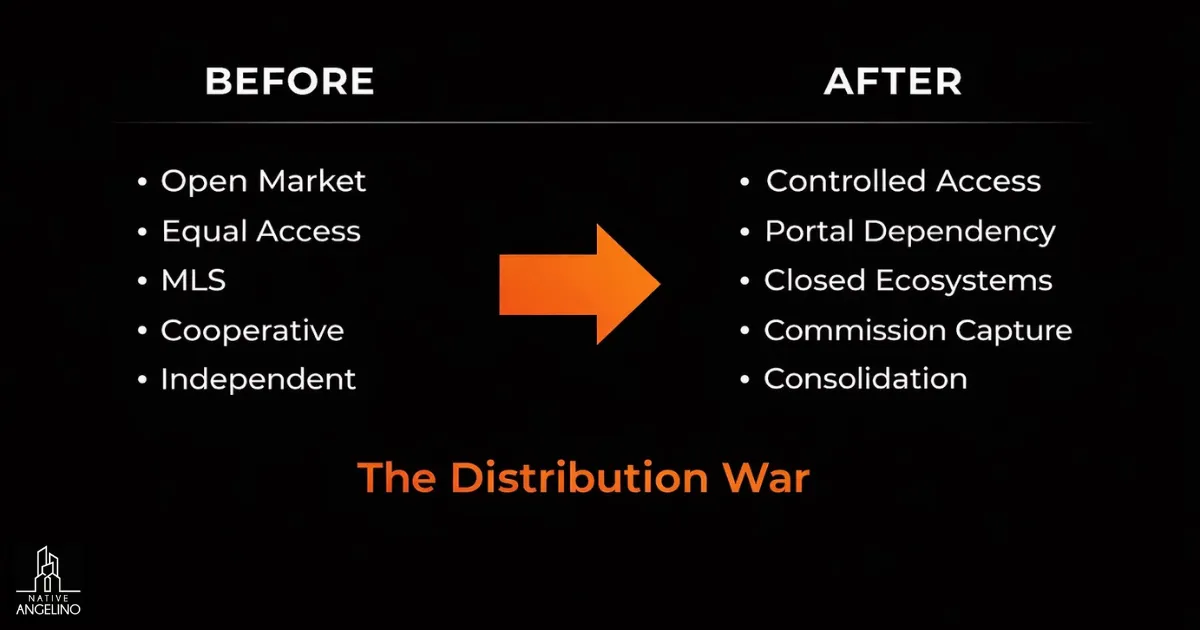
Control of Listing Flow Matters More Than Traditional Market Share
Traditional market share is measured in closed transactions. The new competition is measured earlier, at the moment a listing originates and first reaches a consumer.
The firm that controls where a listing first appears controls which buyers see it, which agents represent those buyers, and whether the transaction stays inside the firm’s ecosystem.
This is the distribution war. It is a sequential set of business decisions made by every major player over the past eighteen months, each designed to move competitive advantage from transaction to pretransaction.
How Redfin Zillow and Brokerage Alliances Reshape Access to Inventory
The Compass and Redfin agreement routes Coming Soon and Private Exclusive listings to Redfin before MLS entry, without displaying days on market or price reduction history. Zillow Preview routes premarket listings from partner brokerages to Zillow and Trulia before MLS activation, with financial incentives to listing agents whose buyers close through a Zillow Preferred Agent. eXp partnered separately with Realtor.com and Homes.com.
Each program is positioned as pro consumer. Each one routes leads back to the originating brokerage or portal partner.
I covered this dynamic in Compass vs Zillow Is Compass Just Redfin on Steroids Part 1 and Compass vs Zillow Dirty Little Secret Part 2 in July 2025. The argument that Compass’s listing strategy was primarily an economic play rather than a consumer service was not the popular view when I first published the podcast Is Compass Just Redfin on Steroids in November 2023.
It is residential brokerage consensus now.
The Weakening of the MLS
The MLS was built on cooperative access. A listing enters a shared database. Every participating agent and every consumer sees the same information at the same time.
Sellers benefit from the broadest possible pool of buyers. These shifts threaten to reduce the MLS from central marketplace to a secondary node in a broker controlled network.
How Premarketing and Preview Systems Bypass the Cooperative Model
Coming soon programs, Zillow Preview, and private listing networks all route listings through proprietary channels before or instead of that cooperative system. Some comply technically with local MLS timing rules.
None serve the cooperative principle the MLS was built to protect.
The distinction between technical compliance and actual intent is exactly where consumers get misled.
Clear Cooperation Compliance Claims and the Fight Over MLS Authority
NAR’s Clear Cooperation Policy required listings to reach the MLS within one business day of public marketing. In March 2025, NAR amended the rule to let local MLSs set their own premarketing windows.
Compass, Rocket, and Redfin then sent that open letter calling out local MLSs including CRMLS for what they described as unwillingness to change.
NAR responded by defending the cooperative marketplace’s pro consumer benefits without addressing the structural incentive problem the letter raised. That nonanswer is its own answer.
The fight over Clear Cooperation is a fight over whether the MLS retains authority to define when and where listings must appear. Compass’s position is that it does not.
Why the MLS Risks Becoming One Node in a Broker Controlled Network
If the largest portals and brokerages build premarket channels that offer agents better leads, more financial incentives, and stronger recruiting tools than the cooperative MLS system, agents will use those channels.
Over time, the MLS becomes secondary distribution, not primary. That changes what a consumer sees when they search for homes, and it changes it in favor of large affiliated firms over independent buyers and sellers.
Industry analyst Rob Hahn put it plainly after the Zillow Preview launch: “They’re absolutely screwed.” That is not hyperbole. It is a structural observation.
The Anti Consumer Reality
When a listing agent is rewarded for keeping a transaction inside the firm’s ecosystem, the advice that agent gives the seller is structurally compromised. That is not a character judgment.
It is how incentives work.
Reduced Exposure Hidden Information and the Risk of Steering
A seller who lists as a Private Exclusive before reaching the open market is, by definition, selling to a smaller pool of buyers than the market contains.
Compass’s own data claims premarketed listings achieve a 2.9 percent higher average close price. Zillow’s own research finds the opposite.
These findings are not reconcilable. They reflect different methodologies, different market conditions, and different incentives in how the data gets presented.
What is not in dispute is this: the seller’s interest in maximum exposure and the agent’s interest in internal commission capture are in direct conflict inside the same transaction.
I covered this in Zillow Got You Started I Closed the Deal and Real Estate Fees Are Broken Disruption and Frustration in May 2025. The incentive structure was visible then. It is more visible now.
Why Internal Matching and Double Sided Incentives Raise Fairness Concerns
When a listing agent at a large brokerage routes a buyer from inside the same firm to a private exclusive listing, the brokerage earns both sides of the commission. That financial incentive is real, measurable, and in direct tension with the obligation to expose the seller’s property to the broadest market.
I asked this question directly in the May 2025 short Real Estate Brokerages Pyramid Scheme or Business Model. The structural critique stands.
A compensation model that rewards internal routing over open market exposure has an anti consumer bias built into its design.
The Oligopoly Reality
Oligopolistic competition means a small number of dominant firms control enough of the market structure to shape how the entire market functions. That is not a future risk in residential real estate.
It is the current condition.
Less Innovation and More Oligopolistic Competition
Compass International Holdings accounts for the mid 20s of total transaction volume. Zillow controls the majority of consumer portal traffic.
The alliance forming between these entities and their brokerage partners is not a competitive response to consumer demand. It is a structural consolidation of market power presented in the language of innovation.
I have watched this play out in financial services and media. The incumbents consolidate before compression reaches full force.
The consolidation provides temporary margin protection. Consumers and smaller market participants absorb the cost.
Where this concentration leads is a question the current data is already beginning to answer. That answer deserves its own analysis.
I covered the early case for this in Compass to Buy Anywhere Real Estate.
The Long Term Risks for Pricing Power Access and Market Transparency
Concentrated control reduces the competitive pressure that disciplines pricing. Reduced price competition means consumers pay more than they would in a genuinely competitive market.
Portal dominance means consumers see a curated version of inventory rather than a complete one. Brokerage dominance means the advice consumers receive is shaped by the advisor’s platform affiliation rather than the client’s actual interest.
None of these outcomes are inevitable. All of them are structurally incentivized by the market architecture currently being built.

Antitrust Portals and the Reinforcement of Oligopoly
The DOJ and FTC chose not to intervene in the Compass Anywhere merger. That decision did not settle whether this concentration benefits the market.
It established how much concentration the current regulatory environment will tolerate.
Why the Compass Anywhere Approval Matters
The Compass Anywhere merger filed required premerger notices with the FTC and the DOJ under Hart Scott Rodino. Neither agency raised public concerns.
The deal closed months ahead of schedule.
Industry merger and acquisition advisor Steve Murray said publicly: “I was very surprised the FTC and DOJ did not have any strong comments. Under their own guidelines, they seemed to have enough reason to comment.”
As of January 9, 2026, the answer on regulatory tolerance is considerably more than most people expected.
Senator Warren and Senator Wyden Warn on Competition and Transparency
Senators Elizabeth Warren and Ron Wyden raised formal concerns about the Compass Anywhere merger, framing it as a threat to competition, consumer choice, and market transparency in housing.
Senator Warren stated: “I warned that a Compass Anywhere merger could raise costs for homebuyers and sellers by reducing competition. Now, instead of addressing the full blown housing crisis flattening American families, the Trump administration has rubber stamped a deal that will make things even worse.”
Their concerns did not stop the approval. They are in the public record, and they name the right question.
When the largest brokerage in the country combines with the second largest and begins building exclusive distribution infrastructure, who protects the consumer’s access to a fair and open market?
The merger approval did not answer that question. It made it more urgent.
How Portals Strengthen and Define the New Oligopolies
The portal alliances do not simply distribute listings. They define which consumers see which properties, which agents receive which leads, and which brokerages capture which transactions.
Zillow Preview gives Zillow direct inventory before MLS activation while preserving its dominant consumer portal position. The Compass Redfin agreement creates a parallel channel routing premarket buyers back to Compass agents.
Together, these alliances are building a market architecture in which access to inventory is determined by platform affiliation, not by the cooperative principle of equal access that the MLS was designed to protect.
What the Biggest Players Want
The strategic goal is durable control over three variables: the agents, the listings, and the transaction flow between them.
Recruiting Power Listing Control and Defensible Distribution Moats
Premarket distribution tools create recruiting leverage. Recruiting leverage brings productive agents. Productive agents bring listings.
Listings create internal matching opportunities. Internal matching generates double sided commissions. Double sided commissions fund more platform development.
Platform development creates more distribution leverage. That is a closed loop.
Once it operates at scale, independent firms and cooperative marketplaces find it structurally difficult to compete. The moat is not one feature.
It is the reinforcing relationship between all of them.
Why Consumer Benefit Is a Useful Message but Not the Core Strategy
Consumer benefit framing is necessary because it is the language that works with regulators, legislators, and the press. Premarket exposure may genuinely benefit some sellers in some markets under some conditions.
Broad portal visibility does give buyers more options than a private listing network. These are real outcomes.
The problem is not that consumer benefit claims are fabricated. The problem is that they function as the public rationale for decisions whose primary driver is brokerage economics.
A firm making a decision based on recruiting leverage, internal commission capture, and platform moat construction describes that decision to the public as a consumer benefit. The description is a tool, not the purpose.
Naming that gap clearly is part of what we do. Clients deserve to understand what is actually happening when someone tells them a private exclusive is the best way to sell a home.
Real Estate Boutiques Win or Lose
Consolidation does not eliminate the case for a boutique brokerage. It makes the case more specific.
Why Boutiques Can Still Compete on Trust Service and Local Knowledge
A client who chooses Native Angelino Real Estate is not choosing us because we have more listings or more portal agreements. They are choosing us because they want a single advisor whose counsel is not shaped by a platform’s lead routing algorithm, an internal matching incentive, or a debt service obligation that requires volume at the expense of judgment.
We Know Los Angeles. At the street level and at the financial markets level.
That combination is not available inside a 340,000 agent network, and it is not available on a portal that routes your inquiry to whichever Preferred Agent paid the highest monthly fee.
Independent. Founder led. Client focused. Those are not taglines for their own sake.
They describe a structural advantage that consolidation creates by eliminating it almost everywhere else.
How Midsize Firms Get Bullied from Both Sides
The firms most threatened are not boutiques and not mega brokerages. They are midsize regional firms that have relied on local brand recognition and MLS access as their competitive moat.
That moat is being drained from two directions at once.
From above, mega brokerages offer premarket distribution tools and recruiting packages that midsize firms cannot match. From below, portal driven lead generation means consumer attention is captured at the portal level before a local brand enters the frame.
Zillow Preview is explicitly a recruiting weapon for participating firms. Midsize firms not in the launch group now face agents asking why their brokerage cannot offer the same tools.
That question does not have a good answer from inside a firm that is neither large enough to build the platform nor small enough to make the lack of one a selling point.
What Comes Next
The consolidation will continue. The distribution war will accelerate.
The question for a buyer or seller in Los Angeles today is not whether these structural forces exist. They do.
Regulatory Pressure Antitrust Scrutiny and Implementation Risks
The DOJ and FTC chose not to intervene in the Compass Anywhere merger. That is not necessarily the end of regulatory scrutiny.
The post merger behavior of Compass International Holdings, its portal relationships, its exclusive distribution programs, and its approach to MLS compliance, will continue to attract legal and regulatory attention.
Compass already dropped its antitrust lawsuit against Zillow in March 2026 following Zillow’s revision of its listing access standards and the simultaneous launch of Zillow Preview. The legal landscape around private listings and portal access is still being written.
Integration risk is real too. Merging 340,000 agents across dozens of brands with different cultures, commission structures, and technology platforms is a multiyear operational problem.
Agent churn, debt service, and the complexity of delivering the promised cost synergies will test whether the scale advantage translates into execution.
What a Healthier Market Structure Would Require
A healthier market starts with acknowledging that the seller’s interest in maximum market exposure and the agent’s interest in internal commission capture are in direct conflict inside the same transaction. That conflict requires either structural separation or transparent disclosure at a level the business currently does not require.
It requires MLS systems with the authority and the will to enforce equal access rules across all participants regardless of scale. It requires portal policies that prioritize consumer access over brokerage alliance economics.
It requires independent advisory counsel to be the standard clients measure their options against, not the exception they have to seek out.
The question is whether the person advising them is aligned with the client or with the platform.
We do not have a portal agreement. We do not have an internal matching program. We do not have 340,000 agents and a debt obligation that requires volume at the expense of judgment.
I have 30 years in financial markets and deep Los Angeles expertise. My obligation is to the client, not the platform.
Frequently Asked Questions
What is real estate brokerage consolidation?
Real estate brokerage consolidation is the process of well capitalized firms acquiring or merging with smaller brokerages, reducing the number of competitors and concentrating market share. AI, the NAR Sitzer Burnett settlement, and new strategic alliances have accelerated this shift. Compass, Rocket Redfin, and Zillow are the key firms driving the industry toward an oligopolistic structure.
Why is real estate brokerage consolidation happening now?
Technology, transparency, and AI have been compressing brokerage margins in residential real estate for years. The Sitzer Burnett settlement accelerated what was already underway. Firms responded by acquiring competitors and forming new alliances to capture listings, defend margins, and protect market share in a system already under structural pressure.
What is the Googlization of information?
Googlization is what happens when the cost of acquiring private or proprietary information approaches zero. As access increases and friction disappears, the value of that information declines and the leverage of those who once controlled it erodes.
The term was introduced by Battelle and Salkever (2003) and expanded by Siva Vaidhyanathan in The Googlization of Everything (2011). Tom Levine modified the framework for real estate beginning in 2022, arguing that when buyers access listing data, price history, and market analytics for free through portals, the role of the intermediary who once controlled that information is fundamentally challenged.
How does the Compass Redfin listing distribution agreement affect a home seller's exposure?
The Compass Redfin Rocket alliance routes Coming Soon and Private Exclusive listings to Redfin before IDX distribution, without displaying days on market or price reduction history. A seller's listing reaches a narrower buyer pool before open market competition begins. The deal directly challenges Zillow and the MLS system. Tom Levine argues the economic beneficiary is the brokerage, not the seller.
What is Zillow Preview and how does it fit into the real estate distribution war?
On March 17, 2026, Zillow launched Zillow Preview, routing premarket listings to Zillow and Trulia before MLS activation. Zillow CEO Jeremy Wacksman framed it as open access to inventory. Zillow's own research found sellers who list privately net 3.7% less in California markets.
Launch partners include Keller Williams, REMAX, HomeServices of America, Side, and United Real Estate. Tom Levine wrote about this dynamic in November 2023, before it entered mainstream industry discussion.
What does the consumer choice narrative in real estate actually mean?
Every major player in real estate consolidation uses similar language. Sellers get flexibility. Buyers get visibility into listing inventory before it reaches the broader market. These are not fabricated statements. They are incomplete statements.
The gap between what is said and what is incentivized is where consumers get hurt. When a portal calls premarket listing access "transparency," it is simultaneously building a proprietary inventory channel that agents outside its ecosystem cannot access on the same terms.
Whoever controls first exposure controls the lead. Whoever controls the lead controls the commission.
Our Platforms
P.O. Box 18044
Beverly Hills CA 90209